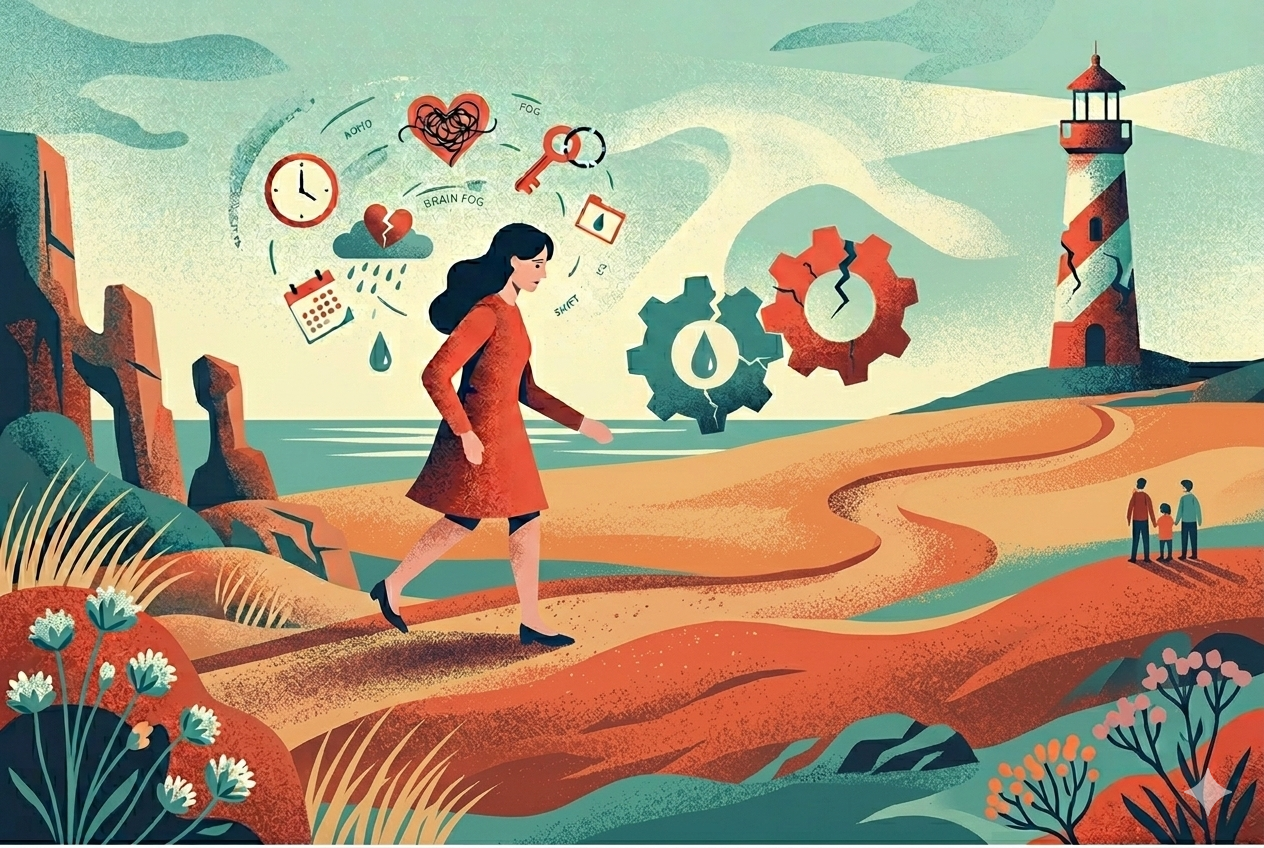
ADHD, Women & Perimenopause: When Hormones Shift and Relationships Feel It Too
If you are in a long-term relationship and suddenly things feel… different — more reactive, more chaotic, more emotionally charged — it can be frightening.
For many couples, the missing piece of the puzzle is this: ADHD in women often shifts significantly during perimenopause. And when it shifts, the relationship feels it too.
This article is designed as an educational tool — not to diagnose, not to label, and certainly not to blame — but to help both partners understand what may be happening, and how to respond with curiosity rather than conclusions.
Why Perimenopause Changes the ADHD Landscape
ADHD in women is frequently underdiagnosed or misdiagnosed for years. Many women have spent decades developing coping strategies that “hold things together” (so called masking)— especially in relationships, parenting, and professional life.
Perimenopause changes the neurochemical balance that helped maintain those strategies.
Oestrogen plays a role in dopamine regulation.
Dopamine is central to attention, emotional regulation, executive functioning, and motivation.
As oestrogen fluctuates, dopamine regulation can become less stable.
What this can look like:
Increased forgetfulness
Heightened emotional sensitivity
More intense overwhelm
Reduced frustration tolerance
Executive dysfunction that feels new or amplified
Sleep disruption worsening everything further
For the woman experiencing this, it can feel like:
“I used to manage. Why can’t I anymore?”
For the partner, it may look like:
“What has happened to you?”
Without understanding, both can quickly move toward blame.
The Relational Impact: Where Couples Get Stuck
In therapy, I often see certain patterns emerge:
The Partner Interprets Change as Withdrawal or Carelessness
Forgetfulness may be seen as lack of interest. Emotional reactivity may be interpreted as hostility. Reduced capacity may be labelled laziness.The Woman Feels Misunderstood and Alone
She may already feel disoriented by her own internal changes. When her partner responds with criticism or “You’re overreacting,” shame increases.Long Relationship History Becomes a Trap
“We’ve been together 20 years — I know you.”
But neurobiology evolves. Hormones shift. Capacity changes. Knowing someone in the past does not automatically mean understanding them in the present.
This is where many couples accidentally escalate conflict.
The Crucial Shift: From Assumption to Enquiry
One of the most protective factors in neurodivergent relationships is intellectual humility.
Instead of:
“You’re just being dramatic.”
“This is no different than before.”
“You always do this.”
Try:
“Something feels different. Help me understand what it’s like for you.”
“Is this feeling harder to manage than it used to be?”
“What would support look like right now?”
Long-term relationships can create an illusion of certainty. But certainty often shuts down curiosity.
When ADHD intersects with perimenopause, the nervous system is under strain. The last thing it needs is judgment layered on top.
What the Partner Can Practically Do
This is not about “walking on eggshells.” It is about building knowledge and responding intentionally.
1. Learn About the Intersection
Read about ADHD in women. Read about perimenopause. Understand that fluctuating hormones can amplify executive dysfunction and emotional intensity.
2. Slow Down Interpretations
If something feels personal, pause before reacting. Ask yourself:
“Is this about me — or is her nervous system overloaded?”
3. Offer Structure Without Control
ADHD brains often benefit from scaffolding:
Shared calendars
Gentle reminders
Breaking tasks into smaller steps
But collaboration is key. Support should not feel parental.
4. Increase Validation
Validation does not mean agreement. It means acknowledging experience.
“I can see this is really overwhelming.”
“That sounds exhausting.”
Nervous systems regulate through feeling understood.
5. Revisit Division of Labour Temporarily
Perimenopause is a transition, not a permanent personality change. Adjusting expectations during this period can prevent long-term resentment.
For the Woman Experiencing This
If you recognise yourself here:
You are not “failing.”
You are not “becoming too much.”
Your brain and body are navigating a complex neurohormonal shift.
Support can include:
Medical consultation
ADHD-informed therapy
Couples therapy focused on psychoeducation
Sleep stabilisation
Clearer communication of needs (even when it feels vulnerable)
Shame thrives in silence. Clarity reduces it.
The Bigger Picture
When couples approach this intersection with knowledge rather than assumption, something powerful happens:
- Conflict softens.
- Defensiveness reduces.
- Partnership strengthens.
The goal is not to eliminate difficulty. It is to respond to difficulty as a team.
Long relationships do not give us the right to assume we fully know our partner. They give us the responsibility to keep learning them.
And sometimes, the most loving stance is simply this:
“I may not fully understand what is happening — but I am willing to learn.”
If this resonates, consider sharing it with your partner as a starting point for conversation. Education can reduce misinterpretation, and misinterpretation is often what harms relationships most. Understanding is not automatic. It is built — together.
For more info on ADHD in relationships read https://mtcounselling.co.uk/adhd-challenges-understanding-the-impact-on-relationships/


